REVIEW · CHICAGO
Walkin’ with Colin: Chicago History-Mystery-Comedy-Tragedy Tour
Book on Viator →Operated by WALKIN' WITH COLIN - A*SHOW*ON*THE*GO! · Bookable on Viator
A quick walk that feels like a storybook. The Walkin’ with Colin Chicago tour strings together art and architecture you can actually see up close, then ties it all to the city’s entertainment, commerce, and the twists in between. I like that you’re not stuck in lecture mode; Colin’s comedy, mystery, and tragedy framing keeps the history moving.
My favorite part is the mix of famous works and unusual details: you’ll spot major art stops like Calder’s Flamingo and Picasso’s 50-foot Untitled, plus you’ll get architectural context for the buildings most visitors only glance at. One thing to plan for: it’s about a 2-hour, 2-mile indoor/outdoor walk with stairs/escalators, so you’ll want at least moderate mobility.
In This Review
- Key points before you go
- Start at 1 N Dearborn, finish at the People’s Palace
- Chagall’s Four Seasons mosaic: the fastest way to learn Chicago’s art “vocabulary”
- Marquette Building: skyscraper swagger, inside-and-out
- Calder’s Flamingo meets Mies and modern Chicago
- The Rookery Building: old Chicago, made beautiful
- Picasso’s 50-foot Untitled: a Chicago-sized signature
- The Chicago Theatre: entertainer history and a ticket question
- Macy’s on State Street: Marshall Field’s department-store power
- Chicago Cultural Center: a public building that feels like a museum
- Why $44 feels like real value for this route
- Who should book Walkin’ with Colin
- Should you book this tour?
- FAQ
- How long is the Walkin’ with Colin tour?
- How far will I walk during the tour?
- Where do I meet, and where does the tour end?
- Are tickets included for all stops?
- What kind of walking and fitness level should I plan for?
- What happens if the weather is poor?
Key points before you go
- 8 stops in about 2 hours with short time at each so you don’t get “tour fatigue.”
- Mostly free entries, with the Chicago Theatre stop requiring a ticket you’ll need to buy separately.
- A maximum of 10 people, which makes it easier to ask questions and keep a good pace.
- Art + architecture + showbiz history in one route, from Chagall mosaic to the People’s Palace.
- Colin’s storytelling style includes photos and short video-style support to help you remember what you saw.
- Plan around weather since it runs outdoors at key moments and works best with good conditions.
Start at 1 N Dearborn, finish at the People’s Palace
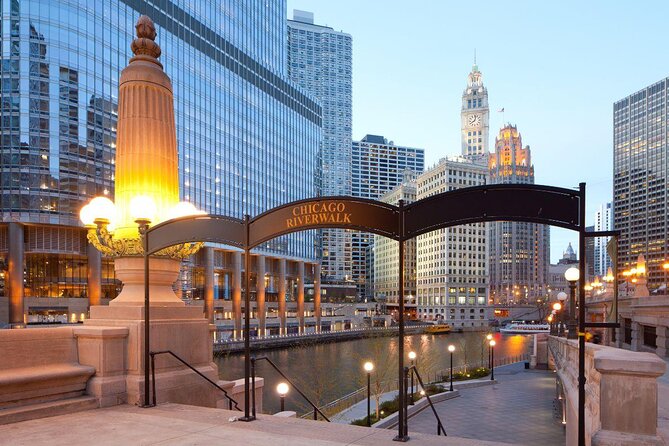
This is a downtown-focused walk that starts at 1 N Dearborn St and ends at the Chicago Cultural Center (78 E Washington St). That matters because you get a clean “arc” to the day: you begin near the classic theater/finance-adjacent block of downtown, then you work your way into the Cultural Center’s grand interior, which is a fitting finish for a tour about Chicago’s public-facing creativity.
The route is small-group and timed to keep things lively. You’ll be on your feet for about two hours and roughly two miles, with some stops inside and some outside, plus the usual Chicago mix of stairs and escalators. If you like walking tours that feel like a guided museum walk—without the museum lines—this fits.
Also note the practical stuff: it’s in English, you get a mobile ticket, and it’s designed to work near public transportation. Service animals are allowed.
You can also read our reviews of more walking tours in Chicago



Chagall’s Four Seasons mosaic: the fastest way to learn Chicago’s art “vocabulary”

Your first real wow moment comes early with Marc Chagall’s Four Seasons. The tour’s pitch is simple: look closely, then learn how this kind of large-scale art changes the way you read a building. Chicago does public art at a big scale, and this stop gives you a quick way to understand why people get emotional about murals and mosaics here.
What I think you’ll enjoy is the way this stop sets the tone for the whole tour. It teaches you to notice materials, symbolism, and composition before you move into more modern objects. You’ll be spending about 15 minutes here, so you’ll have time to actually look, not just snap a photo and rush on.
The practical catch: it’s a short stop, so you’ll want to be ready with your phone camera at the start. (Once you’re moving to the next stop, you won’t have time to circle back.)
Marquette Building: skyscraper swagger, inside-and-out
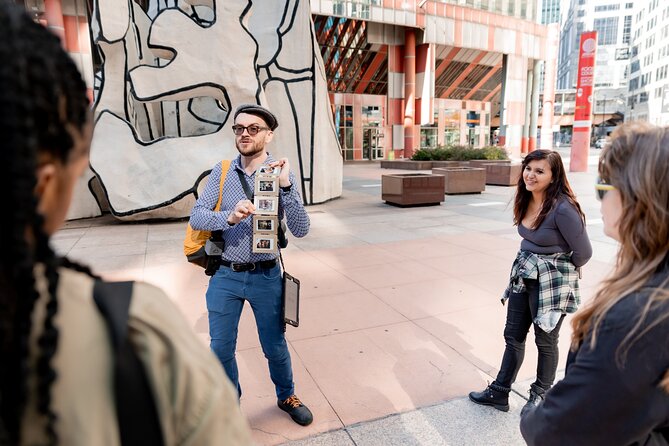
Next up is the Marquette Building, and this is where the tour starts doing something that I always value: connecting “big architecture” to lived details. You’re shown both the exterior and interior, with about 10 minutes allotted. That’s enough time to appreciate why this building is considered one of the older, more important skyscrapers in Chicago, without spending your whole day in one lobby.
This is also one of the stops that helps you understand how Chicago’s identity became global. Tall buildings here weren’t just new shapes—they became symbols for business, ambition, and style. Seeing it through a guided lens helps you notice what regular passersby often skip: transitions between old and new design cues, and how the interior finishes aim to impress.
If you’re a photographer, this is a good early target. Lobbies can vary in lighting, and starting with a high-detail interior stop gives you practice before you hit the modern sculpture and theater sights later.
Calder’s Flamingo meets Mies and modern Chicago
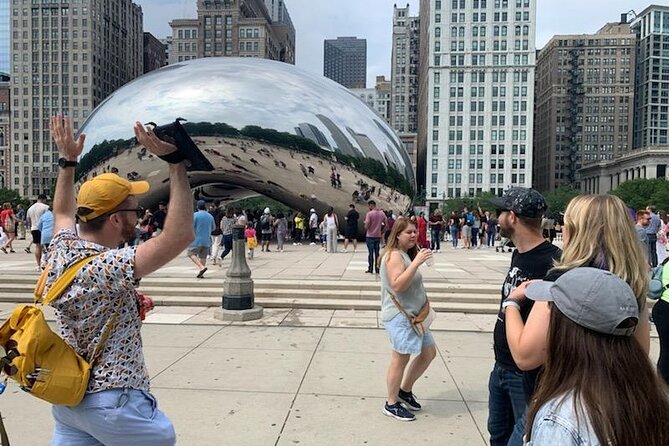
Then comes Calder’s Flamingo, paired in the tour with the nearby presence of Mies van der Rohe. This stop is about 10 minutes, and the tour’s strength here is the angle: modern art isn’t floating in a vacuum. It’s placed in a modern architectural setting, so you start seeing how sculpture and steel can be a conversation.
What you’ll likely notice is how Calder’s work changes your sense of scale. It’s easier to see how abstraction can still feel playful and readable when you’re standing close. And when you add the architecture context—especially the “modern classic” vibe connected to Mies—you get a clearer picture of why Chicago shaped so much of what we now call modern design.
This is one of the stops where Colin’s storytelling style helps the most. A good guide turns a “pretty sculpture” moment into something you remember, because you understand what to look for: balance, movement, and why the setting matters.
The Rookery Building: old Chicago, made beautiful

The Rookery Building stop runs about 15 minutes, and it leans hard into the idea of Chicago’s earliest skyscraper era. The tour frames it as the oldest skyscraper in Chicago and highlights how stunning the building is, not just from the outside, but in the interior experience too.
This is a good place to slow down a bit. Older buildings tend to have layered design: transitions, unexpected details, and spaces that feel designed for people to linger. The tour gives enough time to take that in, but it’s not so long that you’ll start checking your watch.
One practical consideration: because the tour includes indoor/outdoor walking and some stair movement, you’ll want to keep an eye on your shoes. This is the kind of building stop where comfort helps you enjoy the interior rather than rushing to beat the next weather change.
You can also read our reviews of more historical tours in Chicago




Picasso’s 50-foot Untitled: a Chicago-sized signature
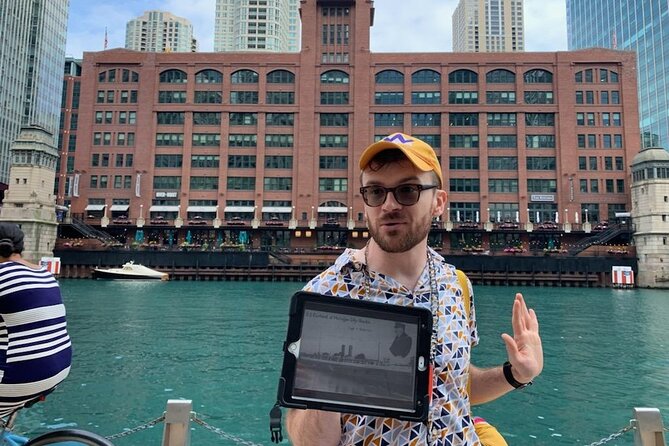
The stop for Picasso’s monumental 50-foot Untitled is about 10 minutes. It’s fast, but it’s the kind of fast that helps you experience scale. A sculpture that tall doesn’t just sit there—it dominates your street-level sightlines, and it changes how you frame nearby buildings.
This is also a strong “composition practice” moment. If you’re the type who likes to photograph buildings and art together, this helps. You’ll see how art and architecture can occupy the same visual frame, even though the forms look totally different.
If you care about the story behind modern art’s public presence, this stop is a good payoff. You get a major name, a big physical statement, and a reminder that Chicago didn’t wait around to bring world-famous works into public view.
The Chicago Theatre: entertainer history and a ticket question
The Chicago Theatre stop is about 15 minutes, and it’s one of the few times the tour involves something that costs extra: admission is not included. That means you should plan to buy the separate ticket if the stop includes an indoor viewing portion for the day’s schedule.
This stop is also the tour’s showbiz brain. The tour connects the theater to Chicago’s reputation for performers and entertainers across time, focusing on how the city’s creative scene shaped inspiration for talent. Even if you’re not a deep theater person, it helps to understand why certain buildings in Chicago become cultural magnets.
Practical tip: because this is the only stop where admission isn’t included, keep that in mind when budgeting. The rest of the stops are marked as free entry in the tour details, so this is the one place where your $44 may not cover every single moment.
Macy’s on State Street: Marshall Field’s department-store power
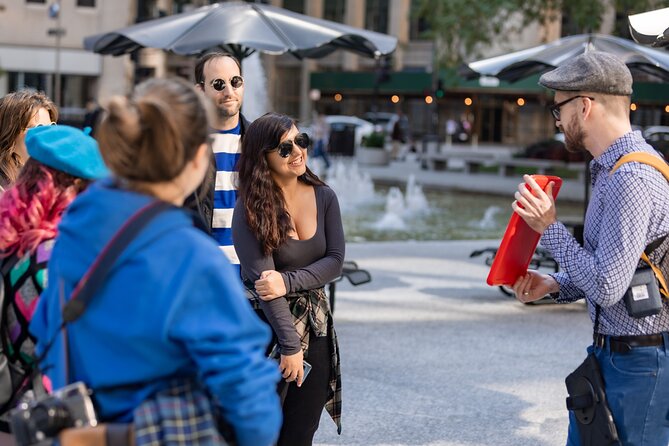
Then the tour shifts from art objects to consumer culture, in a good way. At Macy’s on State Street, the focus is the original Marshall Fields Department Store, described as revolutionary and formerly the biggest in the world. You’re spending about 10 minutes here, which is just enough to understand why department stores mattered beyond shopping.
This is one of the tour’s smartest moves for first-timers: it shows you that history isn’t only monuments and murals. It’s also retail design, crowd behavior, and how cities market themselves. Chicago helped shape modern department-store thinking, and the tour points you toward that larger story.
A helpful angle from the tour’s broader coverage: you may also notice ornate interior details like Tiffany glass domes while you’re there. That’s the kind of visual reward that turns a commerce stop into an architecture stop.
If you don’t love crowds, plan mentally for this environment. It’s still only a short visit on the route, so it doesn’t have to take over your day.
Chicago Cultural Center: a public building that feels like a museum
Your final stop is the Chicago Cultural Center, described as the People’s Palace. You’ll spend about 15 minutes, and the tour highlights the building as a beautiful space with a library legacy. This is the finishing line that makes the whole experience feel coherent: you start with art in mosaic form, you move through skyscrapers and public sculpture, and you end in a grand cultural space that turns the city’s creativity into something you can wander through.
I like that the end stop is about public culture, not just a single famous artifact. The Cultural Center’s interior spaces are designed for people, and that matches the tour’s theme of Chicago’s public-facing identity. You don’t have to be an expert to enjoy it. You just need a few minutes to look up, notice materials, and let the space do the talking.
If the weather turns or you get tired, finishing here is a nice safety net. It’s a natural place to slow down after the walking portion, even if you still want to keep exploring on your own afterward.
Why $44 feels like real value for this route
At $44 per person, the biggest question is what you actually get. This tour packs a lot of famous, photo-worthy Chicago stops into a small group with a guide who keeps the stories moving. Even better: most of the listed entries are free at the stops (with the one notable exception of the Chicago Theatre).
That means you’re not paying extra repeatedly for every location. You’re paying for someone to connect the dots: why these buildings exist where they do, why these artworks belong in public spaces, and how Chicago’s entertainment world and commerce culture fed into the city’s design identity.
Compared with generic “look at the skyline” tours, this gives you more tangible, close-up experiences: mosaics you can focus on, sculpture you can measure against the street, interiors you can actually step into, and a theater stop that links architecture to performance.
Also, the tour is timed at around two hours. That matters. If you’re visiting for a short time, you can fit it between other plans without feeling like you lost half a day.
Who should book Walkin’ with Colin
This tour is a strong match if you want a first taste of Chicago that goes beyond postcards. If you like architecture but also enjoy art, showbiz stories, and humor, you’ll probably have a great time. The tour’s theme—history, mystery, comedy, tragedy—is more than marketing language; it’s how the stops are arranged and explained.
It’s also a good choice if you prefer smaller groups. With a maximum of 10 travelers, you’re less likely to feel lost in a crowd, and the pace stays manageable.
One more practical match: it works best if you can handle uneven sidewalks and the indoor/outdoor rhythm. The tour includes stairs/escalators and movement between sites, so it’s not the right pick if you want a seated-only experience.
Should you book this tour?
Yes, if you want a compact route that makes Chicago feel personal fast. The value comes from the pairing of major art (Chagall, Calder, Picasso), major architecture (Marquette, Rookery), and the city’s cultural story at the finish (Chicago Cultural Center). At $44, with most entries listed as free and a small group size, it’s priced like something you can do early in your trip to help everything else make more sense.
I’d think twice only if you have limited mobility for stairs/escalators or if you strongly dislike walking in mixed weather. Also plan for the one extra paid element at Chicago Theatre so the tour doesn’t surprise you on arrival.
If you’re game for a two-hour downtown story walk, this is one of the most efficient ways to see how Chicago builds culture into concrete, glass, and public art.
FAQ
How long is the Walkin’ with Colin tour?
The tour is about 2 hours.
How far will I walk during the tour?
It’s listed as an adventurous 2-hour, 2-mile walking experience.
Where do I meet, and where does the tour end?
You meet at 1 N Dearborn St, Chicago, IL 60602, and the tour ends at Chicago Cultural Center, 78 E Washington St, Chicago, IL 60602.
Are tickets included for all stops?
Most stops are listed as free admission, but the Chicago Theatre stop is not included, so you may need to purchase that ticket separately.
What kind of walking and fitness level should I plan for?
The tour calls for moderate physical fitness and includes indoor/outdoor walking, stairs/escalators, and trips between locations.
What happens if the weather is poor?
The tour requires good weather. If it’s canceled due to poor weather, you’ll be offered a different date or a full refund.