Two 1893 stories run down Chicago streets. This Devil in the White City Chicago Bus Tour starts at the Chicago Architecture Center with a 45-minute briefing, then rolls you past major landmarks connected to the World’s Columbian Exposition era. It’s true-crime and architecture talk in one package, with a guide keeping the theme moving.
I like that the day begins in the Chicago Architecture Center Lecture Hall, so you get the big context before you’re out looking at buildings. I also appreciate the practical side: a professional and certified guide narrates the route, and you’re on an air-conditioned vehicle for most of the ride. One thing to consider: this is a sightseeing route with multiple get-on/get-off moments and an itinerary that can change, so it won’t feel like a long, in-depth museum crawl or a strict, scene-by-scene novel reenactment.
In This Review
- Key highlights you’ll care about
- Starting at 111 E Wacker Dr: the 45-minute CAC primer
- How this tour connects the 1893 fair to Dr. Henry H. Holmes
- Stop: Art Institute of Chicago views and the Exposition angle
- Auditorium Theatre: culture in the same Chicago frame
- Ida B. Wells house viewing: social history you can’t ignore
- Statue of the Republic: why symbols matter
- Museum of Science and Industry: the fair’s long shadow
- Price and value: what you really get for $50
- What to bring (and what to skip)
- Group size, pacing, and how the bus tour feels
- Who this tour fits best
- Accessibility and mobility: plan ahead for stairs
- Should you book Devil in the White City Chicago Bus Tour?
- FAQ
- FAQ
- Where is the tour’s meeting point?
- What time does the tour start and how long is it?
- What’s included in the $50 ticket price?
- Is food provided during the tour?
- Are pets or service animals allowed?
- Is the tour suitable for people who can’t use stairs?
Key highlights you’ll care about
- 45-minute lecture at the Chicago Architecture Center before you head out on the bus
- Admission to the CAC Galleries included in the ticket price
- A professional, certified guide doing the storytelling and navigation
- Landmark viewing stops tied to the 1893 World’s Fair and the Holmes thread
- Air-conditioned vehicle for a comfortable, mostly seated format
- Small group cap of 50 travelers, which helps the narration stay focused
Starting at 111 E Wacker Dr: the 45-minute CAC primer
Your tour begins at the Chicago Architecture Center, 111 E Wacker Dr, with a 10:30 am start. Expect about 3 hours 30 minutes total, and the tour ends back at the same meeting point.
Before the bus even moves, you settle in for a 45-minute presentation in the CAC Lecture Hall. This is where the tour earns its keep. Instead of jumping straight to famous buildings, you get the framework: the World’s Columbian Exposition in 1893 and the parallel emergence of Dr. Henry H. Holmes. If you already know the general story, the briefing helps you place what you’re seeing on the route. If you’re newer to the tale, this intro makes the rest of the tour way easier to follow.
After the presentation, you head from the CAC to the bus portion of the experience. The CAC also includes admission to its galleries, so the stop isn’t just a quick handshake-and-go. It’s built for orientation.
Practical note: you’ll want to wear shoes that work for quick transitions. The tour requires you to get on and off the bus at several locations, and there’s no promise that every transfer will be leisurely.
You can also read our reviews of more city tours in Chicago



How this tour connects the 1893 fair to Dr. Henry H. Holmes
The pitch is simple: you’re seeing Chicago through two overlapping historical stories—1893’s World’s Columbian Exposition and the rise of Henry H. Holmes. The guide is the glue here, doing narration that ties architecture, civic ambition, and the darker undercurrents of the same era into one ride.
This works best when you treat the tour like a guided theme route, not a book reproduction. The route focuses on major landmarks and what they signal about the city in the late 1800s. And it uses the story of Holmes as a counterpoint—how the same city that builds big public dreams can also mask serious human darkness.
You’ll also get a feel for how Chicago markets itself through buildings. The exposition was about spectacle and persuasion. Even without going into museum-level detail at every stop, the guide helps you read the architecture like evidence: what was celebrated, what was built to impress, and what that says about people and power.
One caution, based on the tour’s structure: if you want the narration to match every beat of the novel, you might feel the emphasis is more on city landmarks than on tracking each plot moment. The bus format naturally favors big public sites over long, scene-by-scene storytelling.
Stop: Art Institute of Chicago views and the Exposition angle
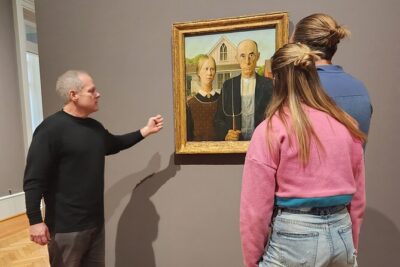
One of the key viewing stops is the Art Institute of Chicago. This is where the tour leans hard into the 1893 World’s Columbian Exposition connection. You’ll discuss why the Art Institute matters in that era, and how the exposition influenced the city’s cultural identity.
Even if you already know the Art Institute today as a major art museum, the tour asks you to look past that. You’ll be thinking about the institution as part of the broader civic push coming out of the fair—how Chicago used art and display to build credibility and status.
The payoff here is clarity. When you learn why a place fits the exposition story, the building stops being random scenery. It becomes a clue for what Chicago wanted to be in 1893 and after.
What to watch for: this is a bus-tour style viewing stop, so don’t expect a full admission day at the Art Institute. Plan to absorb what you can from the street view and the guide’s framing.
Auditorium Theatre: culture in the same Chicago frame
Next up you’ll see the Auditorium Theatre. On this kind of route, the value isn’t just the building’s fame—it’s the way it reinforces the theme that the city was building for attention. The Exposition was about grand public spaces. The Auditorium Theatre fits that same general idea, even though it’s not the fair itself.
In other words: even when you’re not stepping inside, you’re still getting the message. Chicago invested in venues that would make people feel the city had culture, sophistication, and momentum.
This stop is also a nice rhythm change. You go from big exposition discussion to a landmark that feels more like live performance and city life—so the tour doesn’t stay locked to one historical vibe.
Ida B. Wells house viewing: social history you can’t ignore
You’ll also view the Ida B. Wells house. This matters because Wells represents a different kind of Chicago story: one tied to civil rights and fearless public advocacy.
On a tour like this, that’s an important balance. The exposition theme can tilt toward polish and spectacle. Wells pulls you back toward real people, real impact, and the costs of injustice.
Even as a viewing stop, this can land strongly. The guide’s narration is what turns the moment from a quick photo opportunity into something with weight.
Tip: if you’re someone who likes to read faces and bodies in history, Wells is the kind of stop where you might want a minute to process after the bus stops. Don’t treat it like just another skyline shot.






Statue of the Republic: why symbols matter
Another scheduled viewing stop is the Statue of the Republic. Symbolic monuments can sound like trivia until you learn what they were meant to communicate. Here, the tour uses the statue to strengthen the exposition and civic identity connection.
You’ll be thinking about what Chicago chose to display—and what kind of future it wanted to project. Exposition-era Chicago was all about image. And when you look at a statue like this through that lens, it stops being a background landmark and starts acting like a headline.
This is one of those stops where short narration can do a lot of work. Even if you don’t stay long, the guide’s explanation should help you notice the bigger idea: Chicago wasn’t only building for residents. It was building to persuade the world.
Museum of Science and Industry: the fair’s long shadow
The route also includes a viewing stop at the Museum of Science and Industry. This is where the tour can feel like it’s stretching forward—how the exposition-era spirit of progress and public learning echoes in later Chicago institutions.
If you like city history that connects eras, you’ll probably enjoy this part. It’s a reminder that buildings and museums aren’t just entertainment. They’re statements about education, innovation, and who gets access to knowledge.
As with other viewing stops, the bus format means you’ll see the place from the outside and take in the guide’s context. If you want more, you can always plan a separate museum visit later. On this tour, the goal is interpretation, not a full-on exhibit marathon.
Price and value: what you really get for $50
The ticket price is $50.00 per person. For that, you’re getting several things that matter for value: admission to the Chicago Architecture Center galleries, narration by a professional and certified guide, and an air-conditioned vehicle for the route.
What you’re not getting is just as important:
- No hotel pickup or drop-off
- No food or drink included
- No coat check
- No luggage or stroller storage
To judge value for yourself, think about what you’d pay if you tried to recreate this day on your own. Without a guided theme route, you’d spend extra time figuring out which buildings connect to the exposition and Holmes thread. The guide saves you that research time and turns scattered landmarks into a guided story.
Also consider comfort. A 3.5-hour bus tour in Chicago can be hit-or-miss depending on the season. The air-conditioned vehicle takes one variable off your plate.
What to bring (and what to skip)
This tour invites you to bring your own meal: you can bring a bag lunch and beverage onboard the bus. Since food isn’t included, this is a smart move if you tend to get hungry on longer outings.
Because there’s no coat check and no storage for luggage or strollers, pack like you’re doing a fast day in the city:
- Bring only what you can carry easily
- Keep a light layer handy if weather is changeable
- Have a plan for where your bag sits on the bus
And since the tour includes multiple get-on/get-off moments, you’ll be happiest if your tote has a strap and you can move quickly without wrestling zippers.
Group size, pacing, and how the bus tour feels
The tour caps at 50 travelers. That size is big enough to be lively, but small enough that a guide can still keep the narration from turning into background noise.
Pacing is built around sightseeing stops. You’re not doing long indoor experiences at each location. You’ll spend a meaningful chunk at the start with the CAC presentation and gallery time, then shift into a route format with outside viewing stops.
The duration—about 3 hours 30 minutes—fits well if you want a single, focused Chicago outing rather than committing to a full day. It also works as a good “orientation tour” early in your visit, since it gives you a story-driven map of the city’s landmark core.
One more thing: the itinerary is subject to change without notice. That’s common for city tours, but it matters when you’re planning your day. Keep the rest of your schedule flexible.
Who this tour fits best
This is a strong fit if you’re:
- A history buff who likes cities understood through architecture
- A true crime fan interested in how the Holmes story intersects with Chicago’s turn-of-the-century atmosphere
- Someone who learns best with a guide framing what you’re looking at
It may be less ideal if you:
- Want a long, inside-the-building museum day
- Are traveling with very young children (it’s not recommended for them)
- Need extensive mobility accommodations beyond stair-based boarding
The tour does say service animals are allowed and pets are not allowed, so plan accordingly.
Accessibility and mobility: plan ahead for stairs
The route includes getting on and off the bus at multiple locations. If stairs are a barrier for you, notify the operator at least two weeks in advance to ensure an accessible bus is available.
If you’re not sure how your mobility needs will fit with bus transfers, this is the key detail to act on early. Once you’re on the day’s schedule, you’re too late to request the right setup.
Should you book Devil in the White City Chicago Bus Tour?
If you want a single guided ride that links Chicago’s 1893 exposition story to the darker Henry H. Holmes thread, this tour is a practical way to do it—especially because it starts with a 45-minute architecture-focused briefing at the Chicago Architecture Center. The included CAC gallery access and professional narration make the $50 price feel more grounded than a typical sightseeing shuttle.
I’d book it if you like thematic context: you’re happy to learn why each landmark matters rather than expecting every stop to be a deep, ticketed museum visit.
I’d think twice if you’re hoping for strict, scene-by-scene coverage of the novel. The bus format and outside viewing stops will naturally prioritize city landmarks and guiding interpretation over a complete retelling.
FAQ
FAQ
Where is the tour’s meeting point?
You’ll meet at the Chicago Architecture Center, 111 E Wacker Dr, Chicago, IL 60601, USA.
What time does the tour start and how long is it?
The tour starts at 10:30 am and runs for about 3 hours 30 minutes.
What’s included in the $50 ticket price?
Admission to the Chicago Architecture Center galleries is included, along with narration by a professional and certified guide and an air-conditioned vehicle.
Is food provided during the tour?
No. Food and drink aren’t included, but you’re invited to bring a bag lunch and beverage onboard the bus.
Are pets or service animals allowed?
Service animals are allowed. Pets are not allowed.
Is the tour suitable for people who can’t use stairs?
The tour requires getting on and off the bus at several locations. If you can’t use stairs, notify the operator at least two weeks in advance so they can ensure an accessible bus is available.